
Deals
The work you are trying to win, with a number on it
A deal records what the job is worth, who it is with, when you expect to know either way, and how far it has got.
Why the month ahead is usually a guess
And what it takes to make it a list instead.
Ask most owners what they expect to close this month and you get a feeling. The feeling is built from the two jobs that came to mind, not the eleven that are actually open.
A deal turns that into something you can look at. Each one carries a value, a currency, an expected close date and a stage, so the question becomes a list you can read rather than an argument you can have.
It makes the uncomfortable conversations easier too. A deal that has not moved for six weeks is visible to everybody, and somebody can decide whether to push it or write it off honestly.
What a deal records
Value and currency
What the work is worth, in the currency it will be invoiced in, so an export order is not quietly counted as pounds.
Pipeline and stage
Every deal sits in a pipeline at a named stage, and moves along it as things progress. Position means the same thing to everyone.
Expected close date
The day you think you will know either way. It is what turns a pile of deals into a view of your next few weeks.
Open, won or lost
A deal is open until it is not. Marking it won or lost closes it honestly, and keeps the history for whoever asks next year.
The person and the company
Link the contact you are dealing with and the company that will pay, so the deal joins up with everything else you know about them.
Type, source and forecast category
Whether it is new business or a renewal, where it came from, and how confident the team really is in the number.
Running a deal from first quote to closed
A commercial cleaning firm has been asked to quote for three sites.
Create the deal
Usually by converting a qualified lead. Sometimes by adding one directly, when an existing customer asks for more work.
Put a number and a date on it
Enter the value and currency, then an expected close date you would be willing to defend in a Monday meeting.
Link the people involved
Attach the contact who is driving it and the company paying for it, so the history sits with the account and not only with the deal.
Set the stage it has really reached
Choose the pipeline stage that matches what has actually happened, rather than the one you would like to be at.
Keep it moving
Add a note after every conversation, attach the quote you sent, and set a task for the next step before you close the record.
Close it, either way
Mark the deal won or lost. Lost deals are worth keeping: over a year they tell you which stage your work tends to die at.
The board
A view you can read in about ten seconds
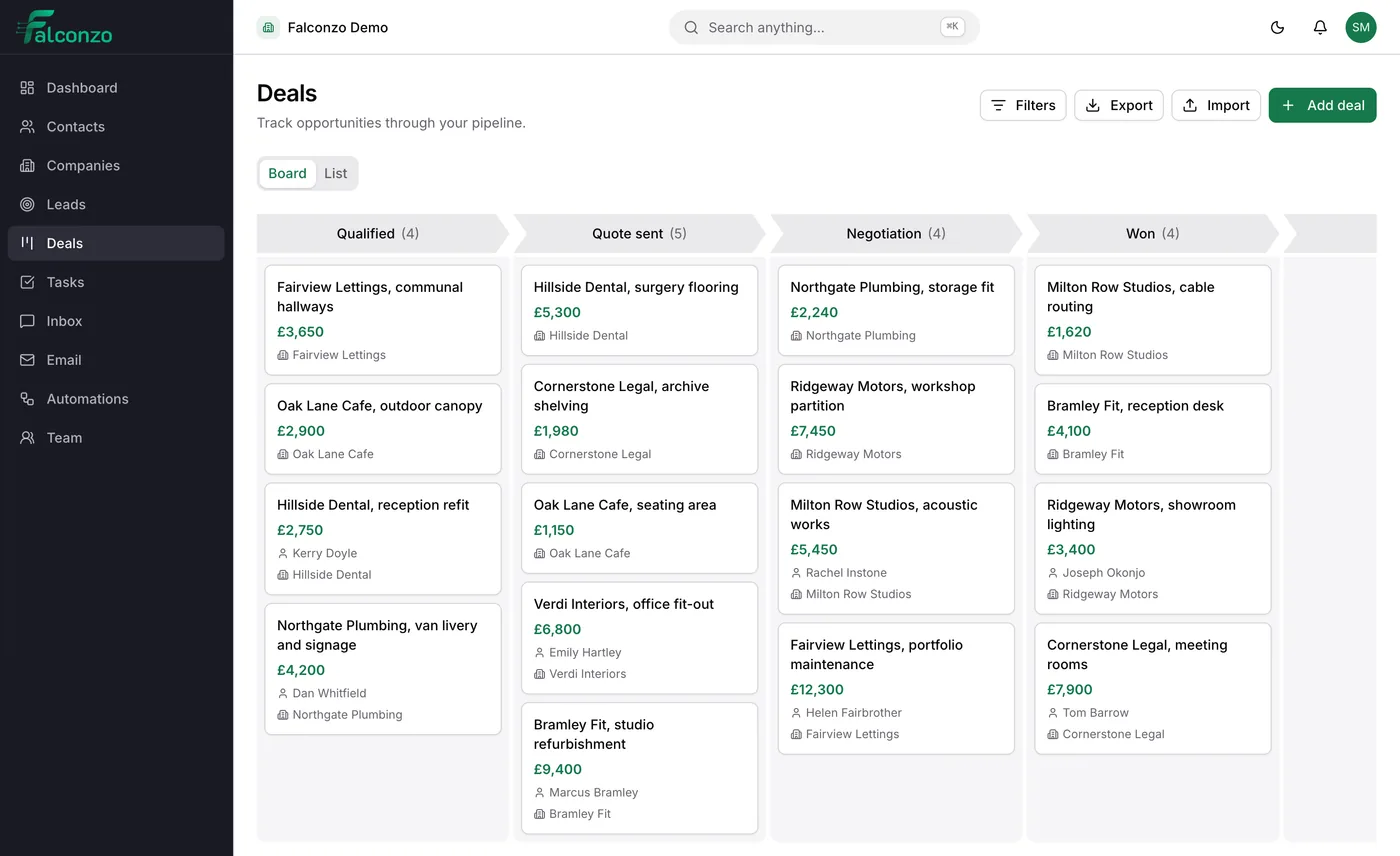
Deals arranged by stage show you the shape of the month without anybody preparing anything. One glance tells you whether the problem is not enough new work or too much sitting untouched at quote sent.
Because a deal belongs to exactly one stage at a time, moving it is a deliberate act. That is what keeps the board honest enough to be worth looking at.
- Stages you name yourself, so the columns match how you sell
- More than one pipeline when different lines of work follow different steps
- An owner on every deal, so no card is nobody's problem
History
Everything that touched the deal stays with it
Six months later, somebody will ask why the price changed. On most systems that means asking around and hoping.
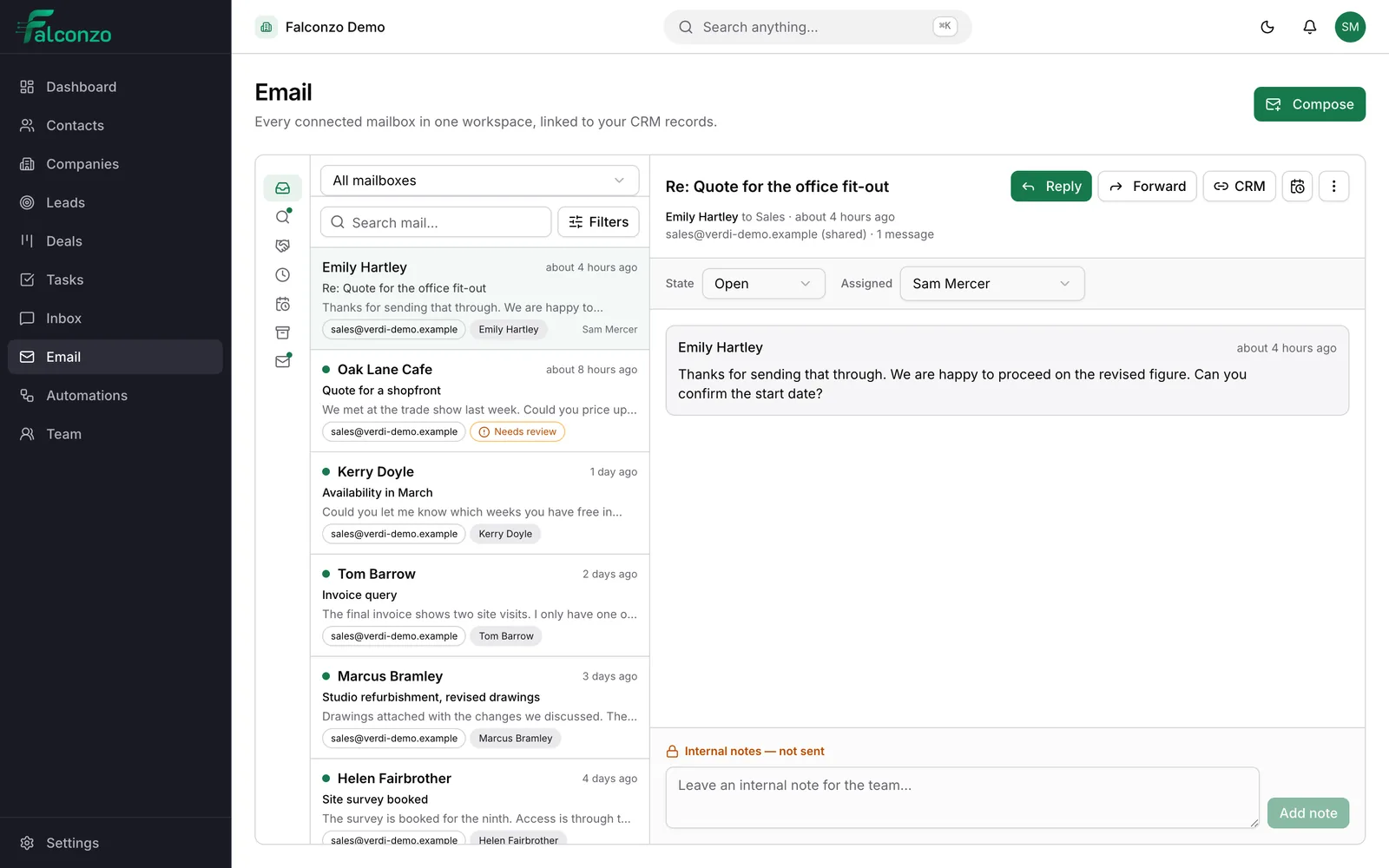
In Falconzo the emails matched to the customer, the notes people wrote, the files they attached and the tasks they completed all sit with the deal. Each field also keeps its own history, so a change of value carries the name of whoever made it and the date it happened.
What you end up with
A straight answer to what is open, what it is worth, who is on it, and when you expect to know.
The follow-up improves almost immediately, because deals with no next task and no recent movement become obvious rather than invisible. Won or lost, you keep the record, and next quarter you can look at where deals really stall instead of guessing.
Put your open work on one board
Book a walkthrough and bring three or four live jobs. We will set up the stages you use and show you what the board looks like with them on it.
Deals work with the rest of Falconzo
A deal on its own is a number. Attached to everything else, it is a customer relationship.
- Pipelines define the stages a deal moves through, in the language your team uses.
- Leads become deals on conversion, together with the contact and the company.
- Tasks make sure every open deal has a dated next step against somebody's name.
- Automations can run when a deal is created or updated, so routine follow-up schedules itself.