
Pipelines
Your sales process, finally written down
Stages named after the steps your business actually takes, so the position of a deal means the same thing to everyone who looks at it.
Nearly there is not a stage
Two salespeople will describe the same deal differently until the steps are agreed.
One says a job is nearly there because the customer was friendly on the phone. The other says it is nearly there because the contract is with their lawyer. Only one of those is nearly there, and until the stages are written down you cannot tell which.
A pipeline is the list of steps a deal goes through, in order, with names that mean something specific. Quote sent. Survey booked. Contract out for signature. A deal sits in exactly one stage at a time, and moving it means something happened.
A window fitter and a software reseller do not sell the same way, and a business doing both should not force one process onto the other. Falconzo lets you run more than one pipeline, each with its own stages.
What you can shape
Stages you name yourself
Use the words your team already says out loud. The stages are yours to define, not a template you have to live around.
More than one pipeline
Keep new business and renewals apart, or run separate processes for two lines of work that genuinely differ.
A board view of the whole thing
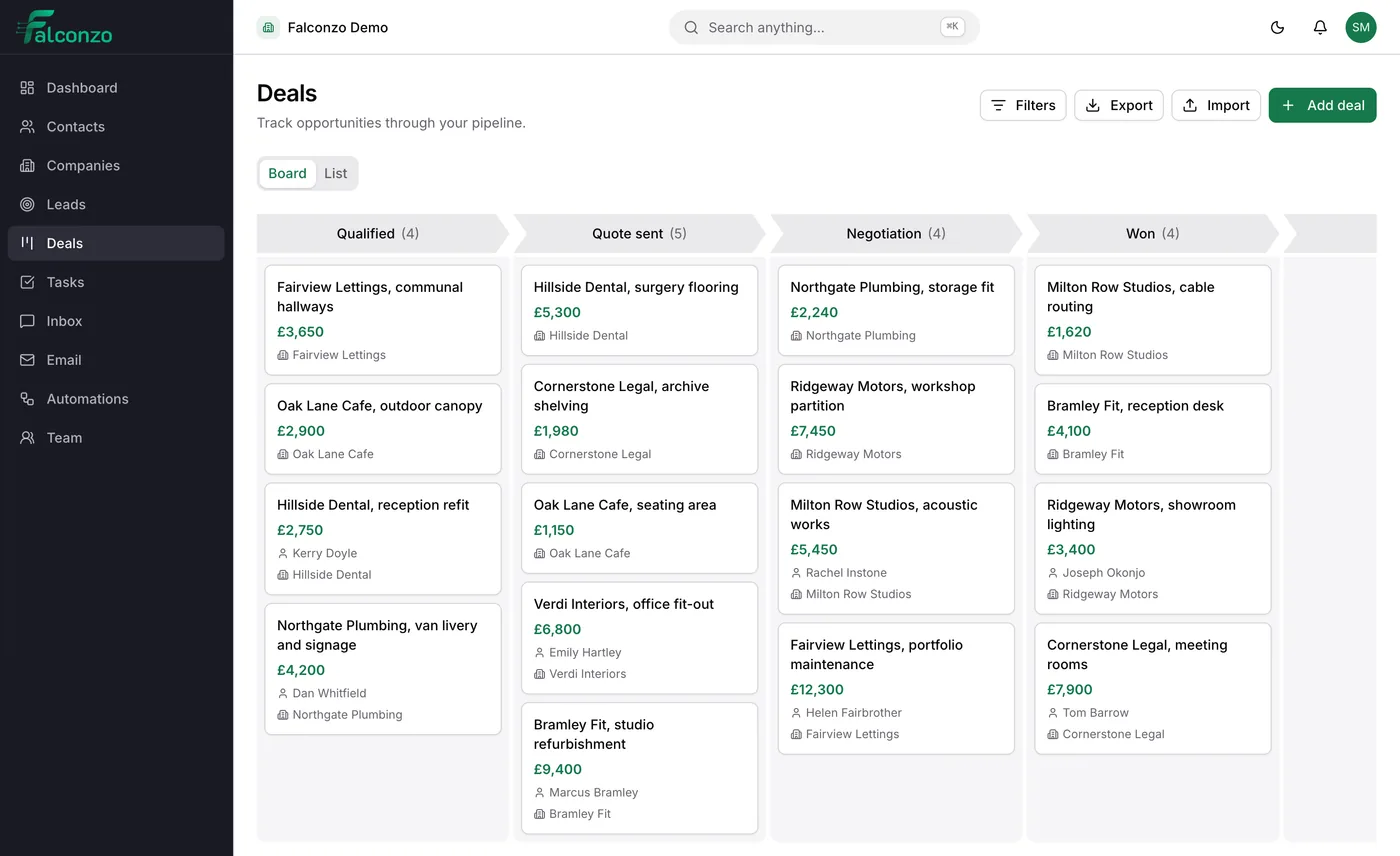
Stages as columns, deals as cards. You can see where work is piling up without anyone preparing a report.
One stage at a time
A deal belongs to a single stage, and moving it is recorded with who did it and when. The board stays honest.
Automations that react to movement
A workflow can run when a deal is updated, so the follow-up a stage always needs can be created for you rather than remembered.
Control over the process itself
Roles and permissions decide who can change the pipeline, so stages are not renamed on a quiet Friday afternoon.
Designing a pipeline that survives contact with reality
The work is mostly thinking. The setting up takes a few minutes.
Write your steps down first, away from the screen
List what happens between the first conversation and a signed order. Most businesses find they have five or six real steps, not twelve.
Create the pipeline and its stages
Name each stage after the thing that has to be true to be in it. Quote sent. Survey booked. Awaiting decision. Not Working on it.
Agree what belongs where
Decide with the team what puts a deal in each stage. A stage nobody can define is a stage that will be used three different ways by three people.
Add a second pipeline only if you need one
If a line of work genuinely follows different steps, give it its own pipeline. If it just has different customers, one pipeline is fine.
Move deals as things happen
The board is only useful if it reflects reality. Move the card when the quote goes out, not when you remember on Thursday.
Look at where things stop
After a month the gaps show themselves. If everything sits at quote sent, the problem is your follow-up, not your marketing.
Choosing stages
Good stages describe evidence, not enthusiasm
The stages that hold up over time are the ones tied to something that either happened or did not. A survey is booked or it is not. A contract has been sent or it has not.
Stages tied to how a conversation felt drift within weeks, because two people never feel the same way about the same customer. Keep the list short enough that everybody remembers it, and specific enough that nobody has to interpret it.
- Name each stage after an event, not a mood
- Five or six stages beats twelve nobody uses properly
- Include a stage for waiting on the customer if that is where deals really sit
Automation
When a deal moves, work can follow it
Every stage has its routine. Quote sent means a chase in five working days. Contract out means somebody should check whether it came back.
Because a workflow can run when a record is updated, that routine does not have to live in anybody's memory. Falconzo can create the follow-up task or update the record for you as the deal moves.
What you end up with
A shared vocabulary for how work progresses, which is worth more than it sounds. Handovers get shorter, and Monday meetings stop being a round of guesswork.
You also get somewhere to look when sales are slow. A pipeline shows whether you have too few enquiries or too many stalled quotes, and those are two very different problems with two very different fixes.
Map your process in one sitting
Book a walkthrough and describe how you sell. We will build the pipeline live and show you your own deals sitting in it.
Pipelines and the rest of Falconzo
- Deals are the things that move through the stages you define here.
- Tasks carry the work each stage generates, with a date and an owner.
- Automations can respond when a deal is created or updated.
- The CRM overview shows how pipelines sit alongside contacts, companies and leads.